Members have the opportunity to receive a Plenary Indulgence on each Feast Day of the Order granted with the usual conditions set by the Church – which are, receiving Communion, praying for the intentions of our Holy Father, Pope Leo, and receiving the Sacrament of Reconciliation.
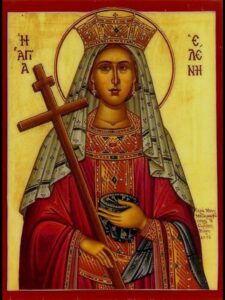
Feast Day: August 18
The Feast of St. Helena is a Feast of the Order. St. Helena is known for finding the site of the Holy Sepulchre and building the first Church on the current site.
Between the years 326-328, Helena took a trip to the Holy Places in the Middle East. During her journey, Helena had many churches constructed, including the one at the site of Jesus Christ’s birth – the Church of the Nativity, Bethlehem and another at the site of his ascension – Church of Eleona on the Mount of Olives.
During this time Jerusalem was still being rebuilt after Titus’ destruction. Around the year 130, Emperor Hadrian had a temple built over the site of Jesus’ death. This temple was believed to be dedicated to Venus. Helena had this temple destroyed and chose a site in this location to be excavated. This led to the discovery of three crosses.
Tradition says Helena brought a woman near death to the crosses. There she had the woman place a hand on all three crosses. Nothing happened when she touched the first two crosses, but when she placed her hand on the third cross she suddenly recovered. Helena declared the third cross to be the True Cross. At this site, Constantine ordered the Church of the Holy Sepulchre to be built.
Feast Day: August 21
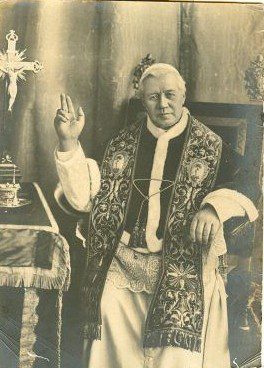
The Feast of Pope St. Pius X is a Feast of the Order. In the first few decades of the Twentieth Century, the reigning pontiff held the senior leadership position of the Order. During this period of time, Pius X intended the title Grand Master to be reserved for the papacy, a political move that linked the Order personally to the Pope without the Order becoming assimilated into the Holy See’s own honors system.
The future Pope Pius X was born Giuseppe Melchiorre Sarto at Riese, near Venice, on 2 June 1835. He was the second of 10 children in a poor family, his father being the village postman. On 18 September,1858, Giuseppe Sarto was ordained priest and became curate at Tombolo. He became popular with his people when he worked to help the sick during a cholera plague that swept northern Italy in the early 1870s. Many of his achievements as pope were directed towards the fulfillment of the ideal: ‘To restore all things in Christ’, a quotation from the Letter to the Ephesians, 1:10. They included the encouragement of more frequent reception of Holy Communion and the admission of children to the Sacrament from the age of seven (an age at which it was felt children could understand the meaning of the Sacrament).
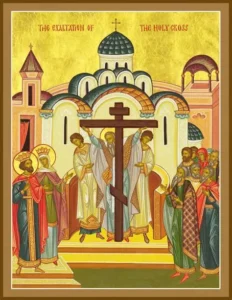
Feast Day: September 14
The feast of the Exaltation of the Holy Cross celebrates two historical events: the discovery of the True Cross by Saint Helena, the mother of the Emperor Constantine, in 320 under the temple of Venus in Jerusalem, and the dedication in 335 of the basilica and shrine built on Calvary by Constantine, which mark the site of the Crucifixion.
Although we commemorate these three historical events today, the core of our celebration is not the physical wood of the Cross or the holy sites where Jesus died and was buried. Our primary focus is the infinite love shown through the selfless and perfect Sacrifice of the Son of God and the boundless mercy that has poured forth upon the world as a result. The Cross itself is a cruel instrument of torture and death. The fact that it is now the symbol of God’s perfect love only further magnifies that love and showcases God’s infinite power to use the worst for the best: to use death to bring life and to transform the greatest act of cruelty ever known into the greatest act of mercy ever bestowed upon the world.
Feast Day: Last Sunday of October
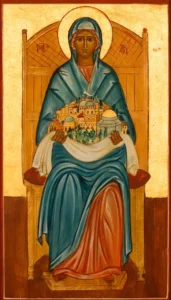
Our Lady was first invoked under this title by the Latin Patriarch of Jerusalem as he entered the Cathedral Basilica of the Holy Sepulchre and consecrated the diocese to Mary on July 15, 1920. He asked her protection over the homeland of the Holy Family because of the ancient and growing tensions that had been threatening its people for generations.
He established this titular feast in her native land in 1927, wrote a special prayer for recitation before the Blessed Sacrament, and erected a church in her honor. The Holy See approved the feast day for the liturgical calendar in a decree asking the faithful to pray to Our Lady as Queen of Palestine for protection over the Holy Land.
In 1983, Pope St. John Paul II addressed an audience of Knights and Dames of the Equestrian Order of the Holy Sepulchre, exhorting them to continue their work in the Holy Land under the protection of the Blessed Virgin Mary. Later, the Grand Master of the Order wrote the pope, requesting that he name Mary Queen of Palestine as the official patroness of the Order. The pope issued the decree in 1994.
May Our Lady Queen of Palestine protect all of her children, and may she inspire and guide world and religious leaders in their quest for peace, especially in this, her homeland, chosen by God.
“For the Lord has chosen Zion; he has desired it. This is my resting place forever; here I will dwell, for I have desired it.” – Psalm 132:13-14